
World Book Day gets its feast on April 23 (the guesstimated birthday of William Shakespeare) and Social Media Day is celebrated today. I suspect most people will celebrate both events by reading social media. At least they’re reading.
To acknowledge the day (after all, a blog about books simply must), I’m going to highlight some classic authors who would have played a mean game of social media if they’d had it available, and a few contemporary authors who do not seem to be afraid of giving away words for free.
1. Samuel Richardson
 His Clarissa was the first item on the syllabus of my undergraduate History of the Novel course. I suspect the reason for this was twofold: 1. Having been published in 1748, it certainly is on anyone’s list of very early novels in English (with apologies to the brilliant Margaret Doody, who will have no truck with modernism of this ilk), and 2. It is quite possibly the longest novel in the English language, at more than 1500 pages and nearly a million words. (English professors everywhere are to be acknowledged for their steadfast efforts to dissuade would-be English majors into more remunerative studies.) Richardson makes my list because Clarissa is epistolary, thus anticipating the Twitter novel by a couple centuries. The text is available via Project Gutenberg; some enterprising soul should help their high school years to hurry along by tweeting it.
Mary Shelley
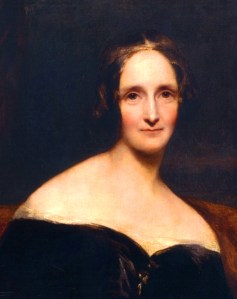 What, you ask, could possibly be more removed from the ephemeral nature of modern tech than the brooding sentiment of gothic horror? Consider this: Shelley wrote Frankenstein on a dare, a whim. It was the result of a gaggle of genius types holed up in a shadowed villa ages before someone invented Boggle. If she could so blithely summon a tale that could capture the imaginations of such diverse talents as Boris Karloff, Gene Wilder, and Kenneth Branagh, do you imagine blogging a bridge too far? No, her blog would be so good and so famous that people would start referring to her by its name.
3. Oscar Wilde
 Can you imagine The Picture of Dorian Gray as an Instagram account? Dollars to donuts Wilde could. What could he not imagine? Dorian recounts his immoral exploits with selfie after selfie, his face “like ivory and rose leaves,” while some JPEG on a Google server degenerates into libertine pixels.
4. Douglas Adams

The author of The Hitchhiker’s Guide to the Galaxy has gone to the restaurant at the end of the universe, but during his earthly sojourn he had a website. In the nineties. As the mind behind the Total Perspective Vortex, he would have appreciated the modern sense that we are but the sum of our likes. Check out his classic How to Stop Worrying and Learn to Love the Internet and tremble at his prescience.
5. Neil Gaiman
 The Venn diagram illustrating Great Writers and Notable Tumblrs would seem to have no intersection, but Gaiman gives the lie to this supposition. Creator of The Ocean at the End of the Lane, he pounded out scripts for episodes of Doctor Who and Babylon 5 and was featured in an episode of The Simpsons. There are rumors that he has written a screenplay of Nicholson Baker’s Fermata for director Robert Zemeckis (get on it, Zemeckis!). If you between the ages of 13 and 17, or simply just as imaginative as Gaiman, you’ll want to visit his Tumblr. Be aware that he does not know it is Social Media Day and has temporarily forsworn human contact in order to write. We wish him well.
 Well, it was. At least, the Globe was on fire, on this very day in 1613. The illustrious Bard was still among the living and had completed all but one of his plays (or all of his plays, depending on your view of the provenance of
  Bibliophenia