
Just recently, I was divested of the bulk of my book collection by my eldest. He had bought a house and had no books, an untenable state of affairs. So he took the living room wall—about 9 x 12 feet of bookcase and 2000 or so of my best friends. (Not to worry, I have overstock!) So, as his “rejections” make their way back home and new purchases accrete, the need for more shelves grows more pressing.
I shared some candidates with my youngest, including one setup that had a place for the TV. “Isn’t that wrong, somehow,” she asked, “to have a TV right next to the books?” Being more glutton than gourmand where media is concerned, I don’t know that I made quite the same distinction, but her point begs one to enquire: What is the opposite of reading?
I don’t think it’s watching TV, or going to the movies, or playing video games, or even going in the out-of-doors (should one be reckless enough to brave THE HEAT DOME). For my money, the opposite of reading is writing. Thus, here are some lovely books on the craft.
1. The Writer’s Idea Book
 Jack Heffron is a terrific writer. He has the additional and rare talent of being a great editor. All this wisdom comes together here and gives you a fun way to break through that block. You can flip to any page and find an idea starter that will take your work in a new direction.
Just so you have the flavor of this brain, here are a few words from the intro:
Writing is an act of hope.
It is a means of carving order from chaos, of challenging one’s own beliefs and assumptions of facing the world with eyes and heart wide open. through writing, we declare a personal identity amid faceless anonymity. We find purpose and beauty and meaning even when the rational mind argues that none of these exist.
I worked with Jack at Writer’s Digest for many years and can tell you that he knows what it’s like from both sides of the editor’s desk. I watched him coach good work from newbie authors and savvy veterans alike and I saw him work, and rework, and rework a piece from pitch to period. He’s a perfectionist, but perfection is attainable for him. If not so much for you, give this book a try.
2. Writing Tools

I really like Roy Peter Clark‘s new book, The Art of X-Ray Reading, which is an avenue into the landscape of writing that is actually enjoyable. However, it involves lots of reading and, this being Opposite Day, that’s right out. So, I’m directing you to his classic. If you want the light-speed version:
- minimize adverbs
- use active verbs
- read your work aloud
None of this helps unless you’ve actually written something. I note with some insight that the first two volumes I’ve offered here are Tenth Anniversary Editions. Why? Because publishers know you still haven’t done the work. Pencils up!
3. Steal Like an Artist

No matter what your creative outlet, Austin Kleon helps you improve your work and (and this is important to some people) get people to notice it. His book Show Your Work is the reason I have a blog, so you can blame him.
Steal Like an Artist explains why your best work is likely to come from exposure to other people’s best work. [NB: This is not a license for plagiarism or copyright infringement. Here ends the PSA.] Also, it has pictures inside.
4. The Elements of Style
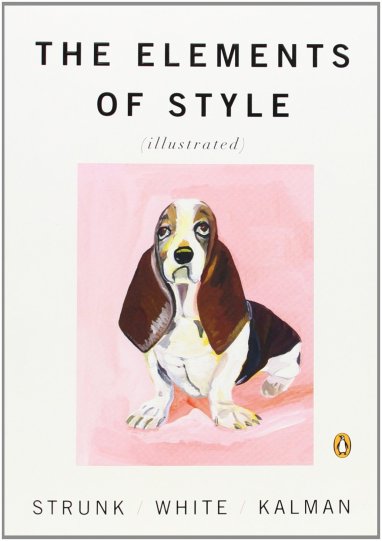
I’m not seriously going to recommend you buy the illustrated version, but it’s pictured here because it is considerably more adorable than the standard.
Strunk and White‘s classic is just that: classic. It’s short, it’s right, and if you internalize the advice therein, you won’t go far wrong.
While I’m on the subject, I have to give a shout out to the definitive biography of the book (yes, you read that correctly) by Mark Garvey, Stylized. If you want to know the story behind the book behind all the stories, this is your guide.
5. The Deluxe Transitive Vampire

Want a grammar book that’s fun? Here’s the ticket! Karen Elizabeth Gordon does lovely things with examples (and delectable clip art [not a phrase, I’ll wager, you’ve read before]) that will have your participles undangled, your antecedents clear, and your modifiers well placed.
Following her good example, I will now provide a “what not to do” and suggest that you never read Eats, Shoots & Leaves and that you eschew the company of those who do. There are two errors in the subtitle alone: As a compound modifier, “zero tolerance” should be hyphenated. But a zero-tolerance approach to punctuation would be an approach that tolerates no punctuation, would it not? So, perhaps it is being internally consistent while still being objectively wrong in every way. Full marks for making a mint off peddling grammar, though, Ms. Truss. (And there are some clever bits.) But, no. I do hereby judge that book by its cover.
Tired, Dear Reader? Of course you are! We all know the very best part of writing is reading. Visit us again, on a day less contrary, and there will be no shortage of fodder for the next time you ask: What should I read next?
 Bibliophenia